by appointment (please phone 0207-482 2002 first)
TOUCHING EARTH - REFLECTIONS ON PAINTING LANDSCAPE
One of my earliest memories of painting (in Freudian terms probably a screen memory) is sitting with my mother at about the age of 6, colouring a picture in the Rupert Bear Annual for their painting competition of that year. I recall in particular my mother advising me to make the sky paler towards the horizon by diluting the blue wash I was using. Free associating (literally, for I have never connected these two things before), my mother has blue eyes – another early memory is of her telling me that they had once been bluer but were pale from all the crying she had done. As the only one of six children to have inherited her blue eyes she may have meant this as a warning to me - perhaps I had been crying myself - not to be a cry baby, rather than the startling confession of sadness which stayed with me. Many of the things that continue to fascinate me as a landscape painter are contained in the first of these memory fragments, if not so obviously the second: colour, light, atmosphere and recession in space.
Thinking about Rupert Bear, one of my childhood favourites, I realize I always admired the work of Alfred Bestall who illustrated and wrote the strip in the Daily Express for 40 years. He is an unusual artistic influence and not one I have ever cited before, but as I write this now he seems a significant one none the less. A hugely underrated talent, his little landscapes around “Nutwood” are masterpieces of economic illustration. The scenes he depicted are essentially naturalistic, capturing something of the hills and woods of his beloved Snowdonia, and yet they also suggest a landscape which might shift from the familiar and the homely to something more mysterious, a place of enchantment that could be inhabited by wizards and giants and horses with wings. Bestall discovered Snowdonia whilst on holiday and went back there most years from his home in Surrey . This I can also relate to, revisiting, as I do, Mediterranean regions (and most recently India ) for my subjects, whilst living in London.
When I did my training at the London Centre for Psychotherapy in the 1980s I was already exhibiting paintings. Many, unfamiliar with my art, assumed that my interest in psychoanalysis would be reflected in work of an interior nature – symbolist or surrealist or at the very least highly subjective. In fact my art has always drawn heavily on the objective world, being concerned very much with specific places and with particular light, times of day, weather and season. The reason is, I think, that painting for me has always been a way of reconnecting with something solid – originally, I suspect, as a young child, with my mother – latterly, as an adult, with mother-nature. It is also about using my hands to make something tangible, guided by instinct more than intellect, which in itself may be connected to a return to a more tactile preverbal state.
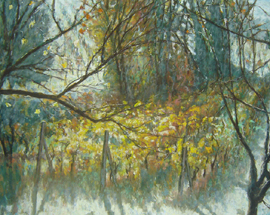
Although concerned with the objective, my response to landscape is always an emotional one. Before beginning a painting I do a great deal of walking, looking and sketching. Many processes are involved, among them familiarizing myself with the essence of the place and seeking out viewpoints that offer satisfying compositions. But I am also alert for other things: that sudden break in the clouds, the surprise of morning mist rising from a valley or the long cast shadows of evening, things that can transform the familiar into something a little less so, (the adult equivalent perhaps of winged horses). The fleeting nature of these events means that memory and invention become essential elements in the final painting. Photographs are a mixed blessing here as they do not capture ones emotional response on seeing such things and may divert one by substituting the objectivity of a mechanical eye instead. Back in the studio I may use photographs for certain types of topographical information that I do not have in my sketch or my memory, but there are dangers in relying on them for more than this.
Over the years I have found myself less and less drawn to the landscape of my native England . Partly this is due to the encroachment of suburbia into the rural and the over cultivation of what remains. I find I am attracted to places which have not changed too much and where the frenetic pace of modern life is largely absent, attracted to them by their sense of timelessness and by the power of natural forces. I like to do a great deal of my work on the spot where the scale of the landscape, the heat of the sun, the wind in my face or the movement of a vast and rolling sky impinge upon me directly as I work. This contact with the elemental seems vital. Perhaps for similar reasons I am also drawn to landscapes which themselves exhibit some human contact. Wild, untamed places do not draw me as much as those where nature and man's efforts to harness her coexist with neither dominating the other. I love the way the mountains and hills of Andalucía and Tuscany , two of my favourite haunts, are terraced on their lower slopes by vineyards and olive groves: the geometry and patterning of cultivation set against the unpredictability of natural forms. The warmth and sensuality of such places as well as their sense of history draw me back again and again.
As an adult my most important artistic influence has been Pierre Bonnard. It is strange to think that following the major exhibition of his work at the Royal Academy in 1966, Bonnard was briefly considered alongside Picasso and Matisse when discussing who was the greatest artist of the 20th century. His reputation has since waned, largely I think because his art remained rooted in observation of the natural world, an idea of painting which has become ever more side-lined. “A latter day impressionist” or “bourgeois painter of domestic pleasures” are some of the ways in which his significance for the modern era is dismissed. I suspect that this is a form of temporary blindness and that in time the importance of observational painting in the endeavour covered broadly by the term “the visual arts” will be recognized again. Bonnard's consistent search to reveal the natural beauty in the world around him, celebrating nature at her most ravishing regardless of the “relevance” of such things, adds to rather than detracts from his genius. His last diary entry read: “I would like to present myself to the young artists of the year 2000 with the wings of a butterfly.” I am not sure how many of today's Y.B.A.s are looking but his paintings continue to shimmer with their own mysterious luminosity for those with eyes to see.
Bonnard sketched everyday direct from nature but painted back in his studio away from the scene. Removed from his subject he could refocus on his first response to it which contained the germ for the painting. The danger otherwise, as he saw it, was to paint a series of appearances none of which equated with that initial sense of revelation when something beautiful is first encountered. Like Monet, he imagined the world as it might be perceived by an infant before knowingness takes over, before the naming of things. Coming back to my London studio I increasingly find there is much work to be done in harnessing and paring down what I have recorded in the field. Revisiting the landscape in my memory becomes as important as my observations made on the spot. Often it is hard to get back to what originally inspired one and everything gets in a muddle. The struggle then becomes one of trying to recover ones inner sense of where the painting needs to go. (Some of these difficulties may have to do with formal / aesthetic considerations rather than with memory and inspiration but therein lies a whole other essay.)
Once again I am aware of the theme of returning to and recapturing things. If at some unconscious level I am seeking to get back in my mind to an ideal of my childhood world (instinctual, pre-verbal and uncontaminated by change), or in an effort at reparation, am attempting to restore the blueness of my mother's eyes, I would not be surprised. There must be plenty written in the psychoanalytic literature on the importance of reparation in the creative process as well as the artist's wish to recover the “omnipotence” of infancy. But in the end what matters to me more as a painter is a sense of wonder before the natural world. This has to be at the heart of my painting regardless of any less conscious motivation. If this feeling comes through in the finished work then I have achieved much of what I set out to do.